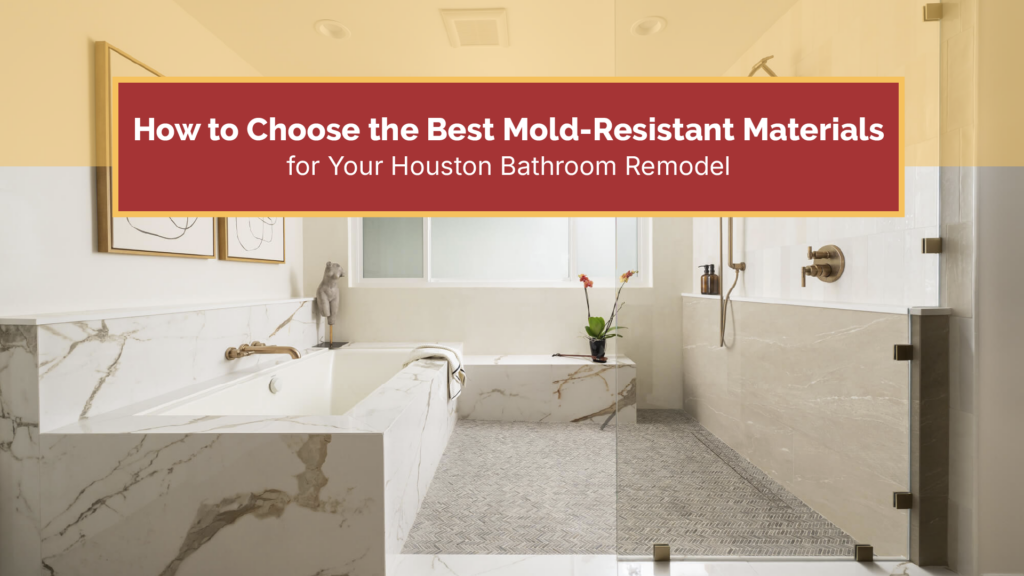
Houston sits at 75 to 90 percent relative humidity for much of the year. That moisture works its way into every bathroom through showers, baths, and even the surrounding air itself. Without the right materials, mold begins forming behind tile and inside walls within just a few years.
This is not a rare occurrence. It is the standard outcome for any Houston bathroom built with the wrong products. Fortunately, choosing mold-resistant materials from the start can prevent this problem entirely — and it does not require sacrificing style.
At KB Kitchen & Bathroom Remodel, we have renovated bathrooms across Houston, Katy, Cypress, Sugar Land, Pearland, and The Woodlands for over 10 years. In this guide, we walk through exactly which materials hold up against Houston’s climate, and which ones to avoid entirely.
Why Houston’s Climate Makes Material Choice So Critical
Houston’s Gulf Coast humidity creates a uniquely demanding environment for bathroom construction. Standard materials that perform well in drier climates often fail here within just a few years.
Houston’s 75 to 80 percent average humidity, combined with unvented bathrooms, leads to mold behind tile within five to ten years in many older homes. Furthermore, that moisture does not stay contained to the shower area. It spreads through drywall, behind vanities, and into subflooring if the wrong materials were used during construction.
The good news is that this outcome is entirely preventable. Spending on proper moisture control is the single best investment in any Houston bathroom remodel. Therefore, choosing the right materials from day one protects both your health and your home’s long-term value.
1. Choose Porcelain Tile Over Ceramic or Natural Stone
Tile selection is the single most important material decision in a Houston bathroom remodel. Porcelain tile is the top choice for Houston bathrooms due to its moisture resistance, durability, and wide design options.
Why porcelain outperforms other tile types:
Porcelain is fired at a higher temperature than standard ceramic tile, making it denser and significantly less porous. As a result, it absorbs far less water — a critical advantage in a climate where standing moisture is a daily reality.
Best practices for porcelain tile selection:
- Choose large-format tiles (24 by 24 inches or larger) to reduce grout lines where mold can grow
- Use small mosaic tiles on shower floors, since more grout lines improve slip resistance despite the trade-off
- Select a slip-resistant rating of at least R10 for shower floors
- Avoid natural stone like marble or travertine for shower floors unless committed to an annual sealing routine, since these materials are vulnerable to moisture damage and etching
2. Install Mold-Resistant Backer Board, Not Standard Drywall
This single decision determines whether your bathroom walls last decades or develop hidden mold within a few years. Standard paper-faced drywall is essentially mold food. It absorbs moisture readily and provides an ideal surface for mold spores to colonize.
What to use instead:
Fiberglass-faced drywall, often called green board or purple board, is engineered to resist moisture and deny mold a food source. This makes it mandatory for bathrooms, not simply an optional upgrade.
For areas with direct water contact — inside the shower and around the tub — cement backer board offers superior protection. Many experienced Houston contractors go a step further and use specialized mold-resistant backer board, such as DensShield or USG Mold Tough, rather than plain cement board for maximum protection.
A smart addition: Reputable contractors include a mold inspection step before closing walls back up during any renovation of an older Houston bathroom. This catches existing moisture problems before they get sealed behind new finishes.
3. Never Skip Waterproof Membranes
Tile alone does not stop water. The membrane underneath it does. Waterproofing is not optional in Houston — it is essential.
Where waterproof membranes are required:
- Beneath all shower floor tile, using a waterproof membrane system such as Schluter-Kerdi or a liquid-applied membrane
- Around the entire shower enclosure, extending well beyond the visible wet area
- Beneath bathroom subfloors, particularly near sinks and toilets where water tends to pool over time
Systems like Schluter-Kerdi or liquid membranes protect tile and framing from moisture, and this single line item is consistently identified as the most important investment in a Houston bathroom remodel. The tile and glass get all the attention, but the waterproofing underneath is what actually protects your home.
4. Select Sealed or Epoxy Grout
Traditional cement-based grout is porous by nature. Consequently, it absorbs water readily and becomes one of the most common places mold develops in a bathroom — even when every other material was chosen correctly.
Better grout options for Houston bathrooms:
- Epoxy grout — virtually non-porous, highly resistant to mold and staining, though more expensive and more difficult to install
- Sealed cement grout — a more affordable option, but requires re-sealing on a regular schedule to maintain its resistance
- Fewer grout lines overall — achieved through large-format tile, which simply reduces the total amount of vulnerable surface
Mold-resistant drywall behind tile, porcelain tile instead of ceramic, and sealed or epoxy grout together create a wall system built specifically to withstand Houston’s climate.
5. Choose Waterproof Flooring
Bathroom flooring faces constant exposure to splashes, spills, and humidity. Therefore, material choice here matters just as much as it does on the walls.
Best flooring options for Houston bathrooms:
- Porcelain tile — the industry standard; extremely durable and fully water-resistant
- Luxury vinyl plank (LVP) — cost-effective, 100% waterproof, and available in designs that mimic wood or stone
- Microcement — a seamless, mold-resistant surface with no grout lines, ideal for a modern wet-room aesthetic
- Solid-surface shower pans — acrylic or cultured marble pans are non-porous and seamless, resisting the thermal shock caused by hot water hitting a cold surface
Materials to avoid entirely: Hardwood and laminate flooring should never be used in a Houston bathroom. Both materials warp, swell, or crack when exposed to consistent moisture — a guaranteed outcome in this climate.
6. Pick Moisture-Resistant Cabinetry and Vanities
The vanity cabinet is frequently overlooked during material planning, yet it sits directly in one of the most moisture-exposed areas of the entire bathroom.
Vanity materials ranked by Houston performance:
- Solid wood (custom) — the best long-term durability, though it comes at a premium price point
- Plywood box construction — a strong mid-range option that can last 25 years or more in Houston’s humidity
- MDF — should be avoided for any vanity touching a wet floor or sink cabinet, since it will delaminate within five to seven years
- Particle board — the weakest option available and should be avoided entirely in a Houston bathroom
Additionally, select fixtures made from stainless steel, brass, or anodized aluminum, since these materials resist rust and corrosion far better than untreated metal or low-grade steel hardware.
7. Upgrade Your Ventilation System
Even the best materials cannot fully protect a bathroom without proper ventilation. Moisture that lingers in the air eventually finds its way into every surface in the room, regardless of how mold-resistant those surfaces are.
Ventilation requirements for Houston bathrooms:
Code requires a minimum of 50 CFM for bathroom exhaust fans. However, for Houston’s climate, bigger is better. Many contractors specifically recommend an exhaust fan rated 80 CFM or higher to properly manage the region’s humidity levels.
Additional ventilation strategies:
- Run the exhaust fan for at least 20 to 30 minutes after every shower
- Consider a humidity-sensing fan that activates automatically when moisture levels rise
- If window placement allows it, incorporate a window for natural airflow, since mold spores thrive in dark, stagnant conditions
8. Use Mold-Resistant Paint and Finishes
Paint is the final layer of defense against mold in areas not covered by tile. However, not all paint performs equally well in a humid bathroom environment.
What to look for:
- Paint specifically formulated with mildew-resistant additives
- Finishes designed for high-humidity environments, which resist peeling far better than standard interior paint
- Semi-gloss or satin sheens, which are easier to wipe down than flat finishes
Opting for mold-resistant paint, or paint with mildew-resistant additives, on any exposed drywall surface adds an extra layer of protection throughout the bathroom.
Materials to Avoid Completely in a Houston Bathroom
Some materials simply are not built for this climate, regardless of how they are installed or maintained.
- Unfinished or untreated wood — absorbs moisture readily and provides an ideal surface for mold growth
- Standard paper-faced drywall — should never be used in any area exposed to bathroom humidity
- Untreated natural stone on shower floors — porous and vulnerable to both mold and etching without a strict sealing routine
- Low-grade steel fixtures — prone to rust and corrosion in a humid environment
- MDF cabinetry in wet zones — will delaminate within a matter of years
What This Means for Your Bathroom Remodel Budget
Choosing mold-resistant materials does add to the upfront cost of a renovation. These choices typically add five to ten percent to upfront cost. However, this investment prevents far more expensive problems down the road.
In Houston, a rip-and-replace bathroom remodel that keeps the existing layout typically runs between $15,500 and $66,000, depending on finish quality. A full gut renovation costs more but allows complete control over every material used — including full waterproofing and mold-resistant backer board behind every wall.
Compare that investment to the cost of remediation. Mold removal, drywall replacement, and repairing water-damaged framing after a failed bathroom often costs far more than the original savings from choosing cheaper materials.
Why Choose KB Kitchen & Bathroom Remodel
At KB Kitchen & Bathroom Remodel, mold prevention is built into every bathroom renovation we complete — not treated as an optional upgrade. Our team uses mold-resistant backer board, proper waterproof membrane systems, and porcelain tile as standard practice on every Houston project.
We serve Houston and all surrounding communities within 50 miles — including Katy, Cypress, Sugar Land, Pearland, and The Woodlands. Our team is BBB Accredited, fully licensed, and committed to transparent, fair pricing on every project.
Ready to Build a Bathroom That Beats Houston’s Humidity?
Do not let the wrong materials turn your bathroom remodel into a mold problem waiting to happen. Contact KB Kitchen & Bathroom Remodel today for a free consultation and quote.
📞 Call us: (713) 902-9693 📧 Email: info@kitchenandbathroom-remodel.com 🌐 Free quote: kitchenandbathroom-remodel.com
Monday to Friday 8am–6pm | Saturday 8am–3pm Serving Houston and 50 miles around.